
The Generational 1978 Topps Billy Hunter Baseball Card
Who knew his lineup-card days were so numbered??

Note: When you click on links to various merchants in this newsletter and make a purchase, this can result in this newsletter earning a commission. Affiliate programs and affiliations include, but are not limited to, the eBay Partner Network and Amazon Associates.
1978 Topps Billy Hunter (#548) - Card of the Day

(affiliate link)
Welcome to a new week, and Happy Groundhog Day!
By the time you read this, Punxsutawney Phil may have already read the verdict on our 2026 winter fate. If not, he’ll be on the job shortly.
Whatever Phil and his brethren across the nation have to say today, we’re going to celebrate this moment — this whole week, actually — when we turn our thoughts toward spring by diving into some baseball cards of players born in Punxsutawney, or thereabouts.
Leading off for our team is Billy Hunter, who not only was born in Phil’s backyard, or vice versa, but who also went to both Indiana High School and State Teachers College at Indiana (now Indiana University) of Pennsylvania. Both of those schools are in both Indiana and Pennsylvania — Indiana, Pennsylvania, in fact.
Hey, I’ll take my Hoosier baseball connections where I can find them, contrived or not.
Hunter signed with the Brooklyn Dodgers out of college in 1948 and spent five summers in their minor league system. Over those years, he worked his way up to the Double-A Fort Worth Cats, not hitting much but playing solid-to-great in the middle infield.
Of course, the big problem with that profile for a young player in the Brooklyn system in the late 1940s and early 1950s was that the Dodgers were set up the middle — no whippersnapper was displacing Jackie Robinson at second or Pee Wee Reese at shortstop.
Even so, as the Texas League MVP in 1952, Hunter was a rising star.
So Brooklyn traded their 24-year-old prospect to the St. Louis Browns for Ray Coleman, Bob Mahoney, Stan Rojek, and cash in October 1952. The Browns, as usual, had openings everywhere, and Hunter spent all of 1953 as their starting shortstop.
In 154 games as a rookie, Hunter hit just .219 with a single home run and 37 RBI, but he did score 50 runs for the 100-loss Browns. He also played with a sterling glove at shortstop, establishing himself as one of the best glovemen in the sport, and he made the American League All-Star team.
Hunter moved with the team when they headed to Baltimore to become the Orioles in 1954, and then played two years for the Yankees, a season-plus for the A’s, and part of a season with the Indians.
None of those campaigns was as successful as his rookie season had been, maybe apart from a higher batting average a few times. After Hunter put up a combined batting line of .185/2 HR/20 RBI in 1958 for the Yanks and Tribe, Cleveland sent him to Triple-A San Diego to start 1959.
Well, to start and end 1959, as it turned out. And to end his big league career, as Hunter never made it back to the majors.
Not as a player.
Three years later, Hunter was back with the Orioles, as a manager in Baltimore’s minor league system. Then, in 1965, former Yankees teammate Hank Bauer became the Orioles’ major league manager and hired Hunter as his third-base coach.
Hunter manned that post for more than 13 years.
Then, in the summer of 1977, the Texas Rangers ran into more trouble in paradise less than two years after firing Billy Martin. Frank Lucchesi led the team to a 35-32 record to wrap up 1975 but finished 1976 ten games below .500. When the team struggled to stay above water in ‘77, Rangers brass fired Lucchesi in June.
In came Eddie Stanky for one game, then Connie Ryan for six. The matter wasn’t settled until Texas hired none other than Billy Hunter on June 28.
It was a match made in baseball heaven, as Hunter guided the Rangers to a 60-33 record to finish the season in second place behind the Royals in the old American League West. Sure, there was an eight-game gulf between the clubs, but imagine if Hunter had been in the dugout all season long!
With that optimism, the team and Hunter rolled into 1978 with their sights set on a division title.
At the same time, Topps rolled out their new set, and for the first time in a generation, the checklist included a solo Billy Hunter card. You can see that one at the top of this post, and the back supplied an unexpected gem:
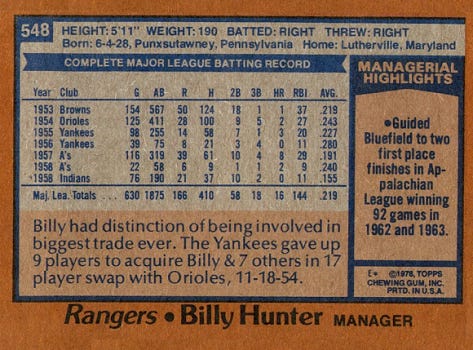
Yep, a full-on career-capper showcasing Hunter’s entire batting record as a major leaguer.
That card might have gone down as a real humdinger had the Hunter-Rangers marriage worked out as planned. The honeymoon ended in April of 1978, though, when the day-to-day grind set in, and Texas was down by eight by the 24th of the month.
The team didn’t give up, and actually held first place for a few days late in the first half. The post-All-Star stretch was a rough one, and Texas fell to fourth place, ten games out, by the end of July.
A late rally left the Rangers with an 86-75 record heading into the final day of the season, five games back of the Royals, but again with hope for the next year.
Hope wasn’t enough the second time around, though, and Texas fired Hunter, handing the reins to Pat Corrales for the last game.
Hunter never did return to the majors, in any capacity. Instead, he headed to Towson State University, where he served as baseball coach and athletic director through 1995 before retiring.
But, while Hunter’s major league career(s) didn’t turn out the way he might have hoped, his encore left collectors with a bonus taste of 1950s baseball.
(John Mizerock is another Punxsutawney-born major leaguer, apparently one of Donruss’ favorite players. We celebrated that link on Mizerock’s recent birthday, right here.)
That Time a Pat Corrales Baseball Card Pulled You Over on Pacific Coast Highway

Hunter was part of a long line of managers the Rangers burned through after firing Billy Martin in July 1975, and the most successful in the string. But even a combined 146-108 record over parts of two seasons couldn’t save Hunter.
When the Rangers fired him on the second-to-last day of the 1978 season, they replaced him with third base coach Corrales.
Corrales stayed in the role through 1980 before becoming Phillies manager in 1982. That’s where we find him in our 1983 sets, looking ready for his closeup.
Read more about Cardboard Corrales right here.
Drinking Coffee with a Fork

Corrales didn’t make it to the postseason with the 1983 Phillies, replaced just past the midpoint by The Pope, Paul Owens. That team featured a slew of aging stars, not the least of which was Steve Carlton, who led the National League in strikeouts for the last time.
Eleven years earlier, Carlton put together one of the handful of most amazing seasons ever by a pitcher.
Drinking Coffee with a Fork chronicles that glorious, terrible summer when Lefty won 27 games…and his Phillies won only 59 in all.
(affiliate link)
Like these stories and want to support them? Now you can contribute any amount you like via PayPal:

… or Buy Me a Coffee:

The 1978 Topps Billy Hunter card is a fascinating piece of baseball history - especially that career-capping back that showcases his entire batting record. It's rare to see manager cards that give such a complete statistical tribute to their playing days. Hunter's journey from defensive standout to successful manager makes this card particularly compelling for collectors interested in multi-dimensional baseball careers.